
 Image caption
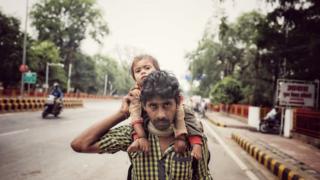
Many migrants have also taken their families along on their difficult journeys
Tens of thousands of daily-wage migrant workers suddenly found themselves without jobs or a source of income when India announced a lockdown on 24 March.
Overnight, the cities they had helped build and run seemed to have turned their backs on them, the trains and buses which should have carried them home suspended.
So with the looming fear of hunger, men, women and children were forced to begin arduous journeys back to their villages – cycling or hitching rides on tuk-tuks, lorries, water tankers and milk vans.
For many, walking was the only option. Some travelled for a few hundred kilometres, while others covered more than a thousand to go home.
They weren’t always alone – some had young children and others had pregnant wives, and the life they had built for themselves packed into their ragtag bags.
Many never made it. Here, the BBC tells the story of just a handful of the hundreds who have lost their lives on the road home.
Sanju Yadav and her daughter Nandini
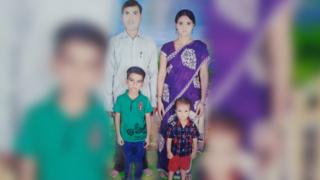 Image caption
Rajan Yadav, his wife Sanju and their two children wanted to make it big in Mumbai
Sanju Yadav and her husband, Rajan, and their two children – Nitin and Nandini – arrived in India’s financial capital, Mumbai, a decade ago with their meagre belongings and dreams of a brighter future.
Her children, she hoped, would thrive growing up in the city.
“It was not like she didn’t like the village life,” Rajan explained. “She just knew that Mumbai offered better opportunities for all of us.”
Indeed, it was Sanju that encouraged Rajan to push himself.
“I used to do an eight-hour shift in a factory. Sanju motivated me do something more, so we bought a food cart and started selling snacks from 16: 00 to 22: 00.
“She pushed me to think big, she used to say that having our business was way better than a job. Job had a fixed salary, but business allowed us to grow.”
Two years ago, all the hard work seemed to be paying off. Rajan used his savings and a bank loan to buy a tuk-tuk. The vehicle-for-hire brought more money for Sanju and her family.
But then came coronavirus.
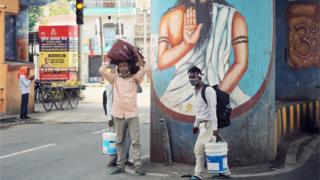 Image caption
Thousands of people have left the cities
The couple first heard Prime Minister Narendra Modi talk about the virus on TV on 19 March. A full, three-week lockdown was announced less than a week later.
They used up most of their savings to pay rent, repay the loan and buy groceries in March and April. They were hoping that the city would reopen in May, but then the lockdown was extended again.
Out of money and options, they decided to go back to their village in Jaunpur district in Uttar Pradesh state. They applied for tickets on the special trains that were being run for migrants, but had no luck for a week.
Desperate and exhausted, they decided to undertake the 1,500-km long journey in their tuk-tuk. The family-of-four left Mumbai on 9 May.
 Image caption
Many were travelling with small children
Rajan would drive from 05: 00 to 11: 00. He would then rest during the day, and at 18: 00 the family would be back on the road until 23: 00. “We ate whatever dry food we had packed and slept on pavements. The prospect of being in the safety of our village kept us going,” he says.
But in the early hours of 12 May – just 200km from their village –