
 Image copyright
Getty Images
Image caption
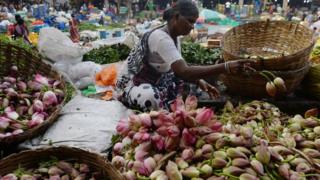
Thousands of vendors sell flowers, fruits and vegetables at the Koyambedu market daily
On 5 May, Bharath Gupta, a district collector in southern India, learnt that the sprawling Koyambedu market in Chennai city was being temporarily closed.
The reason: several vendors and labourers at the market had tested positive for coronavirus, and were being linked to a spate of cases in Chennai and surrounding areas.
Mr Gupta knew of the market because every day, farmers from his district – Chittoor in Andhra Pradesh state – send trucks packed with tomatoes to Koyambedu, which is in the neighbouring state of Tamil Nadu.
But what alarmed him was that the trucks are driven by locals, often accompanied by a helper or cleaner who loads and unloads the cargo, and sometimes a cashier, who collects money from the sale on behalf of farmers. They leave every night around 19: 00, and return to Chittoor the following afternoon.
On 6 May, officials in Chittoor began testing all of those who had been to the market since 20 April. Other districts in Andhra Pradesh, which also supplied to Koyambedu, followed suit.
As of Wednesday, Chittoor had reported 43 new infections which could be traced back to Koyambedu. Meanwhile, across Tamil Nadu as a whole, more than 2,000 new infections – a little over a third of the state’s active cases – have been linked to the market.
India, which has nearly 50,000 active cases, is nearing two months of a countrywide lockdown. But in all that time, grocery stores and food markets have been allowed to stay open, classed as essential services.
But now one of those markets is the source of India’s biggest active cluster, with a far-reaching trail that is as tangled as the country’s food supply chain. Unsurprisingly, it has sparked a public row over who is to blame, but it has also revealed the challenge of regulating India’s bustling, crowded food markets, where space is a luxury and social distancing a fantasy.
Patient zero
Spread over 65 acres in the heart of Chennai, the Koyambedu market is one of the largest in Asia. Wholesale and retail shops selling grains, fruits, vegetables and flowers draw tens of thousands of buyers every day. Add to that the shop owners, truck drivers and daily-wage labourers and it amounts to around a hundred thousand people, on average.
Image copyright
Getty Images
Image caption
The market also draws daily wage labourers from across the city
“We have taken enough precautions, but when a pandemic spreads, it’s bound to spread everywhere in the city,” says D Karthikeyan, a senior official in the Chennai city corporation.
The evidence of their efforts, he adds, is in the fact that the first Covid-19 case from the market was detected on 24 April, one month after the lockdown began.
It was a 54-year-old vegetable vendor who lived in Pulianthope, a densely-populated neighbourhood that has emerged as a hotspot in Chennai.
Mr Karthikeyan says it’s unclear if she contracted the virus from the market or passed it on to people there. “It’s like a chicken and egg story. Which came first?”
Following the trail
He says she led them to 45 positive cases, four of whom worked in the market. And then a barber who ran a shop outside the market tested positive: “That fellow had cut hair for more than 100 people – 25 tested positive and 20 are daily-wage workers in the market.”
So began another round of contact-tracing and testing. It led to truck drivers, daily-wage earners who load and unload the cargo, fruit, vegetable and flower vendors from across Chennai and Tamil Nadu, who travel to the market to buy produce that they take back and sell,